


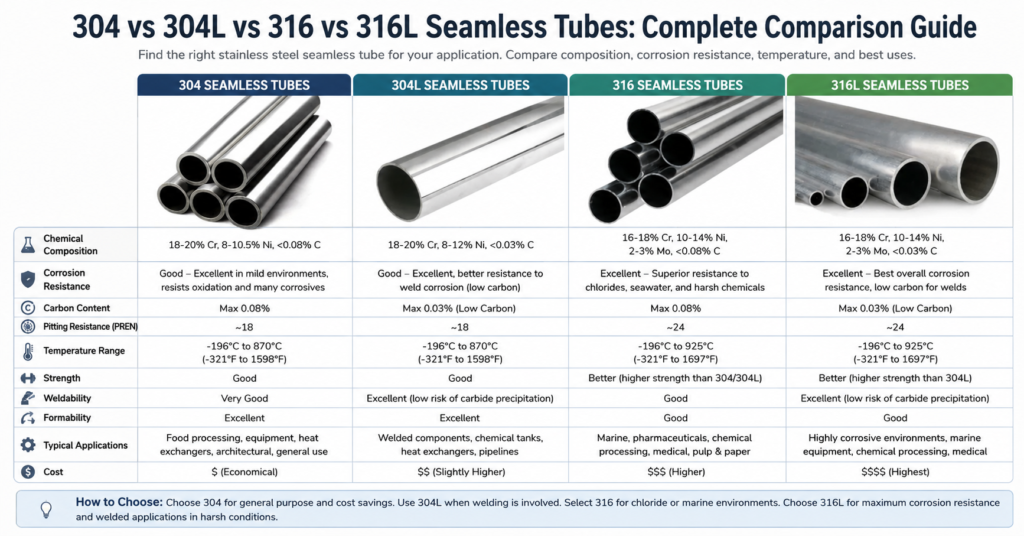
304 vs 304L vs 316 vs 316L Seamless Tubes: Complete Comparison Guide
Stainless steel seamless tubes are among the most widely used materials in the oil and gas, petrochemical, pharmaceutical, marine, and food processing industries. Among the various grades available, Stainless Steel 304, 304L, 316, and 316L Seamless Tubes account for a significant share of industrial applications due to their excellent combination of corrosion resistance, strength, and fabrication characteristics.
Although these four grades belong to the austenitic stainless steel family, differences in chemical composition and carbon content influence their corrosion resistance, weldability, and suitability for specific operating environments. Understanding these differences helps engineers, project managers, and procurement professionals select the most appropriate material for their systems.
Overview of Stainless Steel 304 Seamless Tubes
Stainless Steel 304 Seamless Tubes are often referred to as the workhorse grade of stainless steel. They provide excellent corrosion resistance, good formability, and high strength. These tubes are suitable for a wide range of industrial applications and are manufactured according to ASTM A213, ASTM A269, and ASTM A312 specifications.
Stainless Steel 304 Seamless Tubes contain approximately 18% chromium and 8% nickel, which provide excellent resistance to oxidation and atmospheric corrosion.
Applications of Stainless Steel 304 Seamless Tubes
- Heat exchangers
- Water treatment plants
- Food processing equipment
- Dairy industries
- Pressure vessels
- General engineering applications
- Architectural structures
Overview of Stainless Steel 304L Seamless Tubes
Stainless Steel 304L Seamless Tubes are low-carbon versions of SS 304. The lower carbon content minimizes carbide precipitation during welding and improves resistance to intergranular corrosion.
Because of their superior weldability, Stainless Steel 304L Seamless Tubes are preferred for fabricated components and welded structures used in chemical processing and pharmaceutical industries.
Applications of Stainless Steel 304L Seamless Tubes
- Chemical processing plants
- Welded pressure vessels
- Pharmaceutical equipment
- Pulp and paper industries
- Food and beverage systems
- Structural fabrication
Overview of Stainless Steel 316 Seamless Tubes
Stainless Steel 316 Seamless Tubes contain molybdenum in addition to chromium and nickel. The presence of molybdenum significantly improves resistance to chloride attack and pitting corrosion.
These tubes are widely used in marine environments, offshore platforms, and chemical processing facilities where superior corrosion resistance is required.
Applications of Stainless Steel 316 Seamless Tubes
- Marine equipment
- Heat exchangers
- Petrochemical plants
- Chemical processing systems
- Condensers
- Power generation plants
- Hydraulic systems
Overview of Stainless Steel 316L Seamless Tubes
Stainless Steel 316L Seamless Tubes are low-carbon versions of SS 316. These tubes provide improved weldability and excellent resistance to pitting and crevice corrosion. Their outstanding performance makes them one of the most widely used materials in offshore and pharmaceutical applications.
Applications of Stainless Steel 316L Seamless Tubes
- Oil and gas industry
- Offshore platforms
- Instrumentation tubing systems
- Refineries
- Pharmaceutical industry
- Food processing equipment
- Hydraulic and pneumatic systems
Chemical Composition Comparison
| Grade | Carbon (%) | Chromium (%) | Nickel (%) | Molybdenum (%) |
|---|---|---|---|---|
| 304 | 0.08 Max | 18.0–20.0 | 8.0–10.5 | — |
| 304L | 0.03 Max | 18.0–20.0 | 8.0–12.0 | — |
| 316 | 0.08 Max | 16.0–18.0 | 10.0–14.0 | 2.0–3.0 |
| 316L | 0.03 Max | 16.0–18.0 | 10.0–14.0 | 2.0–3.0 |
Mechanical Properties Comparison
The mechanical properties of stainless steel seamless tubes play an important role in determining their suitability for pressure and temperature applications. Although all four grades belong to the austenitic family, differences in yield strength and carbon content affect their performance.
| Property | 304 | 304L | 316 | 316L |
|---|---|---|---|---|
| Tensile Strength | 515 MPa Min | 485 MPa Min | 515 MPa Min | 485 MPa Min |
| Yield Strength | 205 MPa Min | 170 MPa Min | 205 MPa Min | 170 MPa Min |
| Elongation | 40% | 40% | 40% | 40% |
| Hardness | 92 HRB Max | 92 HRB Max | 95 HRB Max | 95 HRB Max |
In terms of mechanical strength, SS 304 and SS 316 exhibit similar properties, while the low-carbon grades 304L and 316L provide superior weldability.
Corrosion Resistance Comparison
Stainless Steel 304 Seamless Tubes
SS 304 provides excellent resistance against atmospheric corrosion and many organic chemicals. However, it has limited resistance to chloride-containing environments and seawater exposure.
Stainless Steel 304L Seamless Tubes
SS 304L offers corrosion resistance similar to SS 304 while providing improved resistance to intergranular corrosion after welding.
Stainless Steel 316 Seamless Tubes
The addition of molybdenum significantly improves resistance to pitting corrosion, crevice corrosion, and chloride attack. SS 316 is therefore widely used in marine and chemical environments.
Stainless Steel 316L Seamless Tubes
SS 316L combines excellent weldability with superior resistance to aggressive media. It is considered one of the best choices for offshore platforms, pharmaceutical plants, and process piping systems.
Pitting Resistance Equivalent Number (PREN)
| Grade | Approximate PREN Value |
|---|---|
| 304 | 18 |
| 304L | 18 |
| 316 | 24 |
| 316L | 24 |
The higher PREN values of SS 316 and SS 316L indicate better resistance to chloride-induced corrosion.
Weldability Comparison
Low-carbon grades are preferred for welded applications because they reduce carbide precipitation and minimize the risk of intergranular corrosion.
| Grade | Weldability |
|---|---|
| 304 | Very Good |
| 304L | Excellent |
| 316 | Very Good |
| 316L | Excellent |
For pressure vessels, pharmaceutical equipment, and fabricated piping systems, Stainless Steel 304L Seamless Tubes and Stainless Steel 316L Seamless Tubes are generally preferred.
Temperature Resistance
These grades offer excellent oxidation resistance and can withstand elevated temperatures under intermittent service conditions.
| Grade | Maximum Intermittent Temperature |
|---|---|
| 304 | 870°C |
| 304L | 870°C |
| 316 | 870°C |
| 316L | 870°C |
For temperatures exceeding 900°C, stabilized and heat-resistant grades such as Stainless Steel 321H Seamless Tubes, Stainless Steel 347H Seamless Tubes, Stainless Steel 310S Seamless Tubes, and 253MA Stainless Steel Seamless Tubes are generally recommended.
Applicable Standards
Stainless steel seamless tubes are manufactured according to various international standards including:
- ASTM A213
- ASTM A269
- ASTM A312
- ASME SA213
- ASME SA269
- ASME SA312
- EN 10216-5
- NACE MR0175
Industries Using Stainless Steel Seamless Tubes
- Oil and Gas Industry
- Petrochemical Plants
- Chemical Processing Industry
- Power Generation Plants
- Marine Industry
- Food Processing Industry
- Pharmaceutical Industry
- Heat Exchanger Manufacturing
- Water Treatment Plants
- Pulp and Paper Industry
Price Comparison
Material cost is another important factor during grade selection.
| Grade | Relative Cost |
|---|---|
| 304 | Lowest |
| 304L | Slightly Higher |
| 316 | Higher |
| 316L | Highest |
Although Stainless Steel 316 and 316L Seamless Tubes are more expensive, their improved corrosion resistance often reduces maintenance costs and extends service life.
Which Grade Should You Choose?
| Application | Recommended Grade |
|---|---|
| General Industrial Service | SS 304 |
| Welded Structures | SS 304L |
| Marine Applications | SS 316 |
| Offshore and Chemical Plants | SS 316L |
| Pharmaceutical Industry | SS 316L |
| Food Processing Equipment | SS 304 or SS 304L |
Final Conclusion
Stainless Steel 304, 304L, 316, and 316L Seamless Tubes are among the most widely used materials in industrial applications. While SS 304 and SS 304L provide excellent performance for general-purpose service, SS 316 and SS 316L offer enhanced corrosion resistance due to the addition of molybdenum. The final material selection should be based on operating conditions, fabrication requirements, corrosion exposure, and lifecycle cost.
Frequently Asked Questions
What is the difference between SS 304 and SS 304L?
SS 304L contains lower carbon content, resulting in improved weldability and resistance to intergranular corrosion.
Which is better, SS 304 or SS 316?
SS 316 provides superior resistance to chlorides and marine environments because of its molybdenum content.
Why is SS 316L preferred for offshore applications?
Stainless Steel 316L Seamless Tubes provide excellent corrosion resistance, superior weldability, and long service life in aggressive environments.
Which ASTM standards apply to stainless steel seamless tubes?
The most commonly used specifications are ASTM A213, ASTM A269, and ASTM A312.
Global Export Network for Stainless Steel Tubes
MPJ Tubing is a leading manufacturer, exporter, and supplier of Stainless Steel Seamless Tubes to customers across the Middle East, Asia, Africa, Europe, North America, and South America. Our products are supplied in accordance with ASTM, ASME, and EN specifications for oil & gas, petrochemical, power generation, marine, chemical processing, and other critical industries.
Stainless Steel Tubes Export & Supply to the Middle East
Saudi Arabia (KSA), United Arab Emirates (UAE), Iran, Iraq, Jordan, Qatar, Bahrain, Oman, Kuwait, Turkey, Yemen, Syria, and Cyprus.
Stainless Steel Tubes Export & Supply to Asia
Malaysia, India, Taiwan, Cambodia, Singapore, Indonesia, Thailand, Vietnam, South Korea, Japan, Sri Lanka, Maldives, Bangladesh, and Myanmar.
Stainless Steel Tubes Export & Supply to South America
Venezuela, Argentina, Bolivia, Colombia, Ecuador, Guyana, Paraguay, Uruguay, Brazil, and Chile.
Stainless Steel Tubes Export & Supply to Africa
South Africa, Nigeria, Algeria, Angola, Libya, Egypt, Gabon, Sudan, Equatorial Guinea, and the Republic of Congo.
Stainless Steel Tubes Export & Supply to North America
United States (USA), Canada, Mexico, Panama, Costa Rica, Puerto Rico, Trinidad and Tobago, Jamaica, Bahamas, and Denmark.
Stainless Steel Tubes Export & Supply to Europe
Europe: United Kingdom (UK), Netherlands, Russia, Norway, Germany, France, Italy, Spain, Ukraine, Belgium, Greece, Hungary, Albania, Austria, Finland, Ireland, Croatia, Slovenia, Malta, Switzerland, Slovakia, Czech Republic, and Portugal.
Also Read:
Top Tubing and Piping Manufacturer for Industrial Needs
Leading Manufacturer of Stainless Steel Tubes and Piping for Global Markets