Instrumentation Tubing Wall Thickness Selection Guide
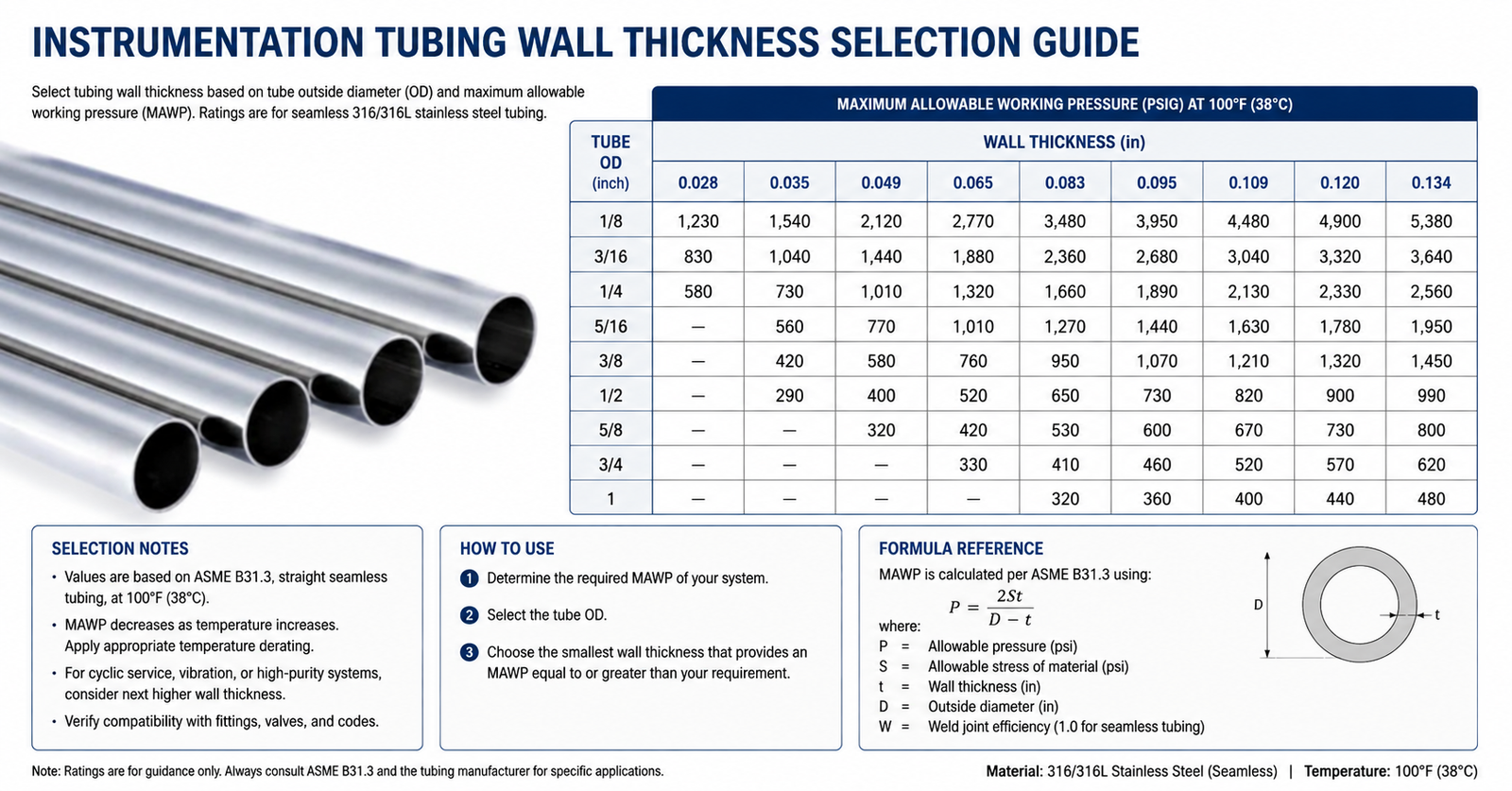
Instrumentation tubing plays a critical role in process control systems, hydraulic equipment, petrochemical plants, and high-pressure applications. Selecting the proper wall thickness is essential for ensuring safety, pressure containment, corrosion resistance, and long-term reliability. Engineers and procurement specialists must consider several factors before choosing the appropriate tubing dimensions and material grade.
This guide explains how to select the correct wall thickness for stainless steel instrumentation tubing and discusses the suitability of various grades including Stainless Steel 304 Seamless Tubes, Stainless Steel 316L Seamless Tubes, and 253MA Stainless Steel Seamless Tubes.
Understanding Instrumentation Tube Dimensions
Instrumentation tubing dimensions are generally specified by:
- Outside Diameter (OD)
- Wall Thickness (WT)
- Inside Diameter (ID)
- Length
- Pressure Rating
The wall thickness significantly influences the pressure-carrying capacity and mechanical strength of the tubing.
Why Wall Thickness Matters
The wall thickness determines:
- Maximum allowable working pressure
- Resistance to vibration and fatigue
- Corrosion allowance
- Service life
- Safety under high-temperature conditions
Choosing tubing with insufficient wall thickness can lead to leakage, burst failures, and costly downtime.
Factors Affecting Wall Thickness Selection
1. Operating Pressure
The higher the system pressure, the greater the required wall thickness. Instrumentation tubing used in hydraulic systems, oil and gas plants, and chemical processing facilities must comply with ASME B31.3 and other international design codes.
Typical pressure applications include:
- Low pressure: up to 1000 psi
- Medium pressure: 1000–5000 psi
- High pressure: above 5000 psi
2. Operating Temperature
Elevated temperatures reduce the strength of stainless steel. Therefore, higher temperatures generally require thicker walls and heat-resistant alloys.
Common high-temperature grades include:
- Stainless Steel 304H Seamless Tubes
- Stainless Steel 310H Seamless Tubes
- Stainless Steel 321H Seamless Tubes
- Stainless Steel 347H Seamless Tubes
- 253MA Stainless Steel Seamless Tube
3. Corrosion Environment
Corrosive media such as chlorides, acids, and sulfur compounds can gradually reduce wall thickness over time. Engineers often provide additional corrosion allowance to compensate for material loss.
Recommended corrosion-resistant grades include:
- Stainless Steel 316 Seamless Tubes
- Stainless Steel 316L Seamless Tubes
- Stainless Steel 904L Seamless Tubes
4. Mechanical Loads and Vibration
Instrumentation tubing installed in offshore platforms, compressors, pumps, and refineries is frequently subjected to vibration and cyclic stresses. Thicker walls improve resistance against fatigue failure and mechanical damage.
Common Instrumentation Tube Sizes
| Outside Diameter | Typical Wall Thickness | Common Applications |
|---|---|---|
| 1/8 inch | 0.028 inch | Pressure gauges |
| 1/4 inch | 0.035 inch | Control systems |
| 3/8 inch | 0.049 inch | Hydraulic systems |
| 1/2 inch | 0.065 inch | Chemical processing |
| 3/4 inch | 0.083 inch | High-pressure service |
| 1 inch | 0.109 inch | Oil and gas applications |
Seamless Tubes versus Welded Tubes
Although both welded and seamless tubes are widely used, seamless tubing offers several advantages:
- Uniform structure
- Superior pressure resistance
- Better mechanical properties
- Enhanced reliability
- Reduced risk of weld-related defects
For critical applications, Stainless Steel Seamless Tubes are generally preferred.
 Material Selection for Instrumentation Tubing
Stainless Steel 304 Seamless Tubes
SS 304 tubing provides excellent corrosion resistance and is suitable for general industrial service, food processing equipment, and water systems.
Stainless Steel 304L Seamless Tubes
The low-carbon variant offers improved weldability and reduced carbide precipitation.
Stainless Steel 316 Seamless Tubes
Containing molybdenum, SS 316 exhibits improved resistance to chlorides and marine environments.
Stainless Steel 316L Seamless Tubes
SS 316L is widely used in offshore platforms, pharmaceutical industries, chemical plants, and process piping systems.
Stainless Steel 321 and 347 Seamless Tubes
These stabilized grades provide excellent resistance to intergranular corrosion and elevated temperatures.
253MA Stainless Steel Seamless Tube
253MA is a high-performance austenitic stainless steel developed for high-temperature service. It offers exceptional oxidation resistance, creep strength, and superior mechanical properties at temperatures exceeding 1000°C.
Applicable Standards
Instrumentation tubing is manufactured according to several international specifications, including:
- ASTM A213
- ASTM A269
- ASTM A511
- ASME SA213
- ASME B31.3
- EN 10216-5
Industries Using Instrumentation Tubing
- Oil and Gas
- Petrochemical Plants
- Chemical Processing
- Power Generation
- Marine Industry
- Pharmaceutical Industry
- Food Processing Plants
- Hydraulic Systems
Final Conclusion
Selecting the proper instrumentation tubing wall thickness is essential for ensuring safety, reliability, and long service life. Factors such as pressure, temperature, corrosion resistance, and mechanical loads must all be considered during material selection. Stainless Steel 304 Seamless Tubes, Stainless Steel 316L Seamless Tubes, and 253MA Stainless Steel Seamless Tubes are among the most widely used materials for demanding industrial applications.
Understanding wall thickness requirements and selecting the appropriate grade according to ASTM and ASME standards helps engineers and procurement professionals optimize performance while reducing maintenance costs and downtime.
Frequently Asked Questions
What wall thickness is used for instrumentation tubing?
Typical wall thicknesses range from 0.028 inch to 0.109 inch depending on pressure and operating conditions.
Why are seamless tubes preferred for high-pressure applications?
Seamless tubes provide better pressure resistance and eliminate weld-related defects, making them suitable for critical systems.
Which stainless steel grade is best for corrosive environments?
Stainless Steel 316L Seamless Tubes and Stainless Steel 904L Seamless Tubes provide superior resistance to chloride and acidic environments.
Which grade is suitable for high-temperature service?
253MA Stainless Steel Seamless Tube, Stainless Steel 310S Seamless Tubes, and Stainless Steel 347H Seamless Tubes are commonly used for elevated temperature applications.
Global Export Network for Stainless Steel Tubes
MPJ Tubing is a leading manufacturer, exporter, and supplier of Stainless Steel Seamless Tubes to customers across the Middle East, Asia, Africa, Europe, North America, and South America. Our products are supplied in accordance with ASTM, ASME, and EN specifications for oil & gas, petrochemical, power generation, marine, chemical processing, and other critical industries.
Stainless Steel Tubes Export & Supply to the Middle East
Saudi Arabia (KSA), United Arab Emirates (UAE), Iran, Iraq, Jordan, Qatar, Bahrain, Oman, Kuwait, Turkey, Yemen, Syria, and Cyprus.
Stainless Steel Tubes Export & Supply to Asia
Malaysia, India, Taiwan, Cambodia, Singapore, Indonesia, Thailand, Vietnam, South Korea, Japan, Sri Lanka, Maldives, Bangladesh, and Myanmar.
Stainless Steel Tubes Export & Supply to South America
Venezuela, Argentina, Bolivia, Colombia, Ecuador, Guyana, Paraguay, Uruguay, Brazil, and Chile.
Stainless Steel Tubes Export & Supply to Africa
South Africa, Nigeria, Algeria, Angola, Libya, Egypt, Gabon, Sudan, Equatorial Guinea, and the Republic of Congo.
Stainless Steel Tubes Export & Supply to North America
United States (USA), Canada, Mexico, Panama, Costa Rica, Puerto Rico, Trinidad and Tobago, Jamaica, Bahamas, and Denmark.
Stainless Steel Tubes Export & Supply to Europe
Europe: United Kingdom (UK), Netherlands, Russia, Norway, Germany, France, Italy, Spain, Ukraine, Belgium, Greece, Hungary, Albania, Austria, Finland, Ireland, Croatia, Slovenia, Malta, Switzerland, Slovakia, Czech Republic, and Portugal.
Also Read:
Top Tubing and Piping Manufacturer for Industrial Needs
Leading Manufacturer of Stainless Steel Tubes and Piping for Global Markets
304 vs 304L vs 316 vs 316L Seamless Tubes
